
Nepal-China Border CATASTROPHIC Flash Flood: Hundreds Dead, 400+ Missing – Massive Mudslide Engulfs Border
Catastrophic flash flood hits Nepal-China border after earthquake triggers massive landslide. 95+ confirmed dead, hundreds missing. Live coverage, death toll updates, and rescue efforts.

Nepal-China Border CATASTROPHIC Flash Flood: Hundreds Dead, 400+ Missing – Massive Mudslide Engulfs Border
BREAKING: Catastrophic Flash Flood Hits Nepal-China Border – 95+ Dead, Hundreds Missing
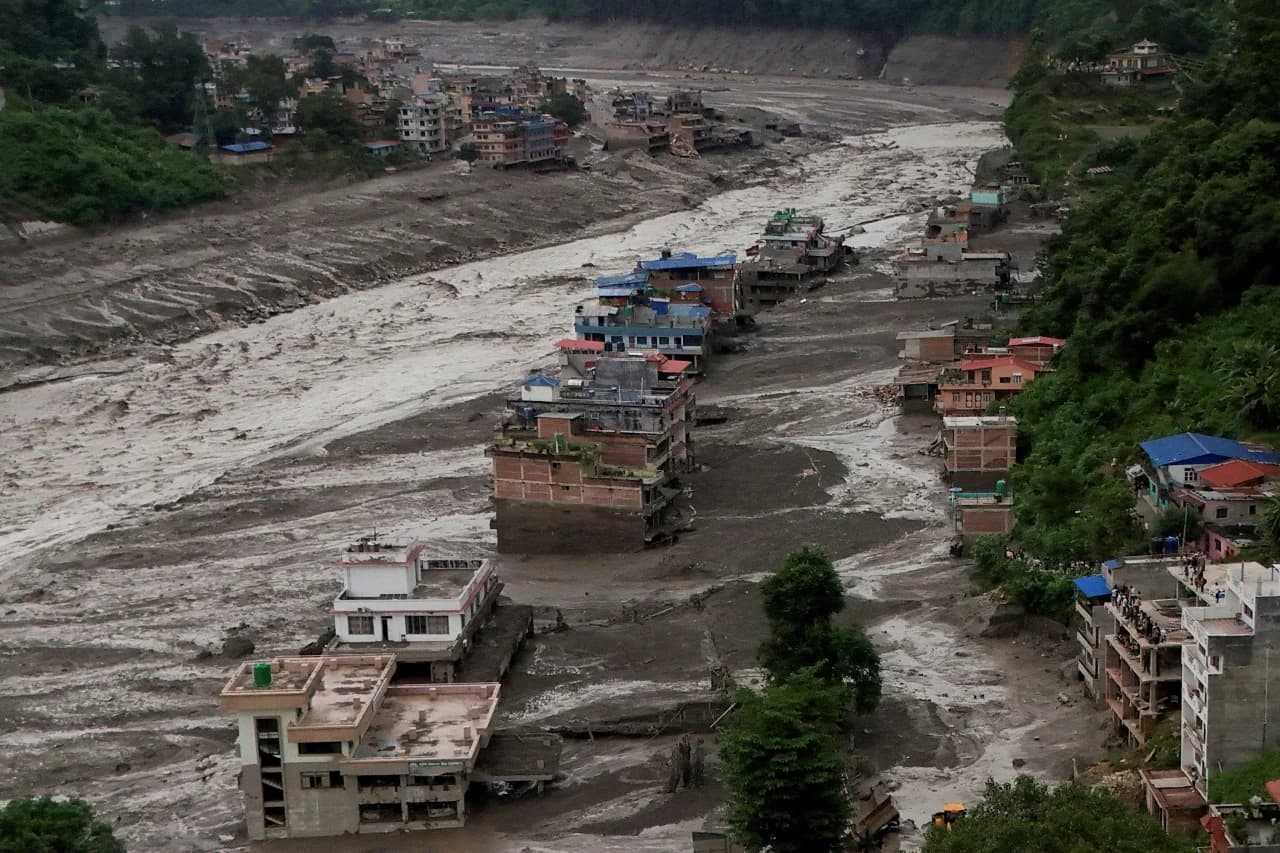
A devastating flash flood has struck the Nepal-China border region, killing at least 95 people and leaving hundreds of foreign tourists, travelers, and workers missing. The disaster began when an earthquake triggered a massive landslide that blocked the Bhote Koshi river, releasing a torrent of water downstream that swept through villages and destroyed critical infrastructure on both sides of the border.
The scale of destruction is staggering. Security camera footage shows enormous waves of muddy water—estimated at 5 to 6 meters high—engulfing the Nepal-China border crossing in less than a minute. The floodwaters have submerged entire towns, collapsed buildings, swept away bridges, and left rescue teams struggling to reach stranded survivors.
This is one of the most severe disasters to hit the Himalayan region in recent years.
Nepal-China Flash Flood: Death Toll and Missing Persons
Current casualties:
| Location | Confirmed Dead | Missing | |----------|----------------|---------| | Nepal | At least 95 | ~400 (including 90 Italians + foreign nationals) | | China (Tibet) | 3 confirmed | 265 | | Total | 98+ | 665+ |
However, authorities warn the true death toll is likely to rise significantly once floodwaters recede and rescue teams can access all affected areas.
Breakdown of missing persons in Nepal: - ~400 tourists and travelers missing across affected districts - 90 Italian nationals confirmed missing (Italian foreign ministry) - 60 construction workers missing from an under-construction hydropower project in northern Nepal - Hundreds of foreign nationals unaccounted for
In China's Tibet region, authorities report 265 people missing from Gyirong county alone, with ongoing rescue operations hampered by thick mud and ongoing rainfall.
What Triggered the Disaster? Earthquake Causes Catastrophic Landslide
Initial cause: Nepal's foreign minister Shishir Khanal confirmed that an earthquake triggered a massive landslide that blocked the Bhote Koshi river, setting off a cascade of disasters.
According to experts at the International Centre for Integrated Mountain Development (ICIMOD) in Kathmandu, the landslide likely took the form of an "ice rock avalanche from a glacier on the Nepal side" that dammed the river.
How it happened: 1. Earthquake strikes the Nepal-China border region 2. Earthquake triggers massive ice and rock avalanche from Himalayan glacier 3. Avalanche blocks Bhote Koshi river (natural dam) 4. Blocked river creates sudden buildup of water 5. Water pressure breaks through dam 6. Catastrophic surge of water + debris floods downstream 7. Mudslide engulfs villages, border crossing, and infrastructure in minutes
An eyewitness helicopter pilot told CNN he saw water waves "as high as five to six meters" sweeping through villages, carrying "big trees and vehicles" downstream. "It was a very scary situation," the pilot said. "I have never witnessed the power of nature unfold like this."
The Destruction: Dramatic Footage Shows Apocalyptic Devastation
Security camera footage of the Nepal-China border crossing shows the shocking moment muddy floodwaters crashed through, with people seen running desperately as the water appears to wipe out everything in its path. The video captures the sheer force and speed of the flood—it engulfed the border area in less than a minute.
Major areas devastated:
Bidur, Nepal – A town located ~50 kilometers (31 miles) northwest of Kathmandu was hit hard. Videos show torrential floodwater tearing through the town, bursting riverbanks, causing multi-storey buildings to collapse, and washing away bridges completely.
Trishuli River region, Nuwakot district – Drone footage from Indian news agency ANI shows floodwaters rushing through the district with multiple riverside buildings submerged in mud. Located 35-45 miles northwest of Kathmandu, Nuwakot has been identified as one of the areas hardest hit by the disaster.
Gyirong county, Tibet, China – The Gyirong border port was "engulfed by an explosive mudslide," according to Chinese state media. Video footage shows the mudslide sweeping through the port area with devastating force. Chinese rescue teams reported finding mud more than 1.5 meters (5 feet) thick in some locations.
The Nepal-China border crossing – Completely overwhelmed and destroyed in less than a minute. This critical border crossing is now impassable, severing connections between the two nations.
Rescue Efforts: Helicopters Winching People from Rooftops
Rescue operations are ongoing but extremely challenging. The Nepali army has deployed helicopters to conduct dramatic rescues, with footage showing people being winched up from muddy waters and clambering from roof terraces into hovering aircraft.
Rescue challenges: - High floodwaters prevent helicopters from landing; they must hover above flood levels - Ongoing rainfall continues to complicate rescue operations - Road blockages – Chinese rescue teams are still clearing mud-covered roads to access affected areas - Thick mud – More than 1.5 meters of mud covers properties, making ground access extremely difficult - Landslide risk – Mountain slopes continue to be unstable; more mudslides possible
One dramatic rescue: Video footage shows a survivor climbing from a rooftop onto a helicopter's landing gear after appearing to remove their shirt to wave and attract the aircraft's attention.
Rescue deployment: - Nepal: Helicopters conducting rooftop rescues and winching operations - China: 600+ firefighters deployed with rescue dogs, life detectors, inflatable boats, and specialized equipment - China's funding: Allocated approximately $17 million in natural disaster relief funds for immediate rescue and relief efforts - Chinese military: Local military officials coordinating response with loaders and excavators clearing roads
Climate Change Connection: Nepal's Vulnerability to Glacier Hazards
This disaster highlights a growing crisis: climate change is destabilizing Himalayan glaciers. Nepal sits in one of the world's most rapidly warming regions and faces increasing risks from glacier-related hazards.
Key climate science: - Ice loss accelerating: Glaciers across the Hindu Kush Himalaya (including Nepal) have lost ice at double the rate since 2000 compared to earlier decades - Nearly 2 million people at risk: Live downstream of melting Himalayan glaciers - Glacial lake outbursts: Known as "inland tsunamis," these occur when pools of meltwater become too full and burst their banks, sending water cascading down mountainsides - Increasing frequency: These cascading hazards are becoming more common as glaciers destabilize
Similar recent disaster: A similar catastrophic flood in the same region last year was traced to a glacial lake outburst in neighboring Tibet. Experts cannot yet confirm what role, if any, a glacial lake burst played in this current disaster.
Saswata Sanyal, an expert at ICIMOD, explained: "These are cascading hazards. What happens in the icy mountains can quickly flood towns downstream. While avalanches can be caused by several factors, climate change often plays a role."
Political Implications: A Test for Nepal's Young Prime Minister
This disaster comes as a major test for Nepal's newly elected government. Prime Minister Balen Shah, 36, a rapper-turned-leader, took office just five months ago following a Gen-Z led anti-corruption movement.
Shah was sworn in in March with promises to clean up national politics and address widespread grievances over lack of opportunities for young people. However, he has yet to publicly comment on the flooding disaster.
Political complexities: - Shah will need to coordinate with India (Nepal's southern neighbor) and China (northern neighbor) during rescue efforts - Requires diplomatic finesse: Shah previously took a fiercely nationalist stance toward both nations - 2023 China tension: As Kathmandu mayor, Shah canceled a trip to China after Beijing released a map that didn't acknowledge Nepal's updated 2020 political map claiming some disputed territories
The disaster will test Shah's leadership and ability to work with neighboring powers during a crisis.
Nepal Earthquake and Landslide: Cascading Disaster Chain
The sequence of events highlights how one geological event can trigger a cascade of disasters:
1. Earthquake strikes – Unsettled the unstable Himalayan terrain 2. Landslide triggered – Massive ice and rock avalanche from glacier dislodged 3. River blocked – Avalanche created natural dam across Bhote Koshi river 4. Water builds up – Backed-up water created increasing pressure 5. Dam fails – Water pressure overwhelmed the natural blockage 6. Flash flood unleashed – Explosive surge of water, ice, rock, and debris 7. Mudslide forms – Flood mixed with terrain material, creating devastating mudslide 8. Multiple casualties – Villages, border crossing, infrastructure destroyed
This "cascading hazard" is increasingly common in the Himalayan region.
International Response and Relief Efforts
Global response is mobilizing:
China: - Deployed 600+ firefighters with specialized equipment - Allocated $17 million in emergency relief funds - Xi Jinping urged "all-out" search efforts, signaling top-level government response - Military units on standby due to ongoing landslide risks
Nepal: - Deploying helicopters for rescue operations - Working with tourism board to coordinate missing person searches - Italian foreign ministry actively coordinating for 90 missing Italian nationals - Local police and army coordinating rescue efforts
International coordination: - Italy's foreign ministry reported 90 Italian nationals missing - Multiple countries coordinating to locate their citizens - Rescue teams facing coordination challenges due to destroyed infrastructure
What Comes Next: Recovery and Long-Term Implications
Immediate priorities: 1. Find survivors – Race against time as missing persons are expected to be found in the following days 2. Clear roads – Chinese teams working to remove mud and debris to access isolated areas 3. Provide emergency relief – Shelter, food, water, medical care for displaced survivors 4. Stabilize terrain – Monitor for additional landslides and mudslides
Long-term concerns: - Climate adaptation – How will Nepal and China prepare for increasing glacier hazards? - Infrastructure rebuilding – Border crossing, hydropower projects, local structures - Refugee flows – Thousands displaced by floodwaters will need relocation assistance - Investigation – Full geological analysis of what triggered the initial landslide
Breaking News: Live Updates and Developing Story
This is a rapidly evolving disaster. Death tolls and missing person counts are expected to change as rescue operations continue and waters recede. Key updates include:
- 11:39 AM EDT: At least 95 confirmed dead in Nepal, 3 in China, with 665+ missing
- Ongoing: Chinese road clearing to enable rescue operations
- Ongoing: Helicopter rescues in Nepal
- Pending: Final casualty figures once floodwaters recede
Video Evidence: Witnessing the Disaster's Scale
Eyewitness accounts: - Helicopter pilot testimony: "Water waves as high as 5-6 meters... debris hurtling down and mixing with fresh water... I have never witnessed the power of nature unfold like this" - Border crossing video: Shows the shocking moment floodwater engulfed the crossing - Drone footage: Reveals the scale of destruction through Nuwakot district - Army rescue videos: Show dramatic helicopter winching operations from rooftops
The Scale of the Disaster
This is a tragedy of historic proportions for the Nepal-China border region:
- 95+ confirmed dead (expected to rise significantly)
- 665+ missing (including 90 Italian nationals and hundreds of foreign tourists)
- Critical infrastructure destroyed (border crossing, bridges, roads)
- Hundreds of homes and buildings submerged
- Massive mudslide engulfed border port in seconds
- Entire villages buried under mud
The human cost continues to mount as rescue teams work around the clock.
Get the Briefing
Join our newsletter to get the latest analysis and breaking news delivered straight to your inbox.
No spam. Unsubscribe anytime.