
What Is End-to-End Encryption (E2EE) and How Does It Actually Protect You?

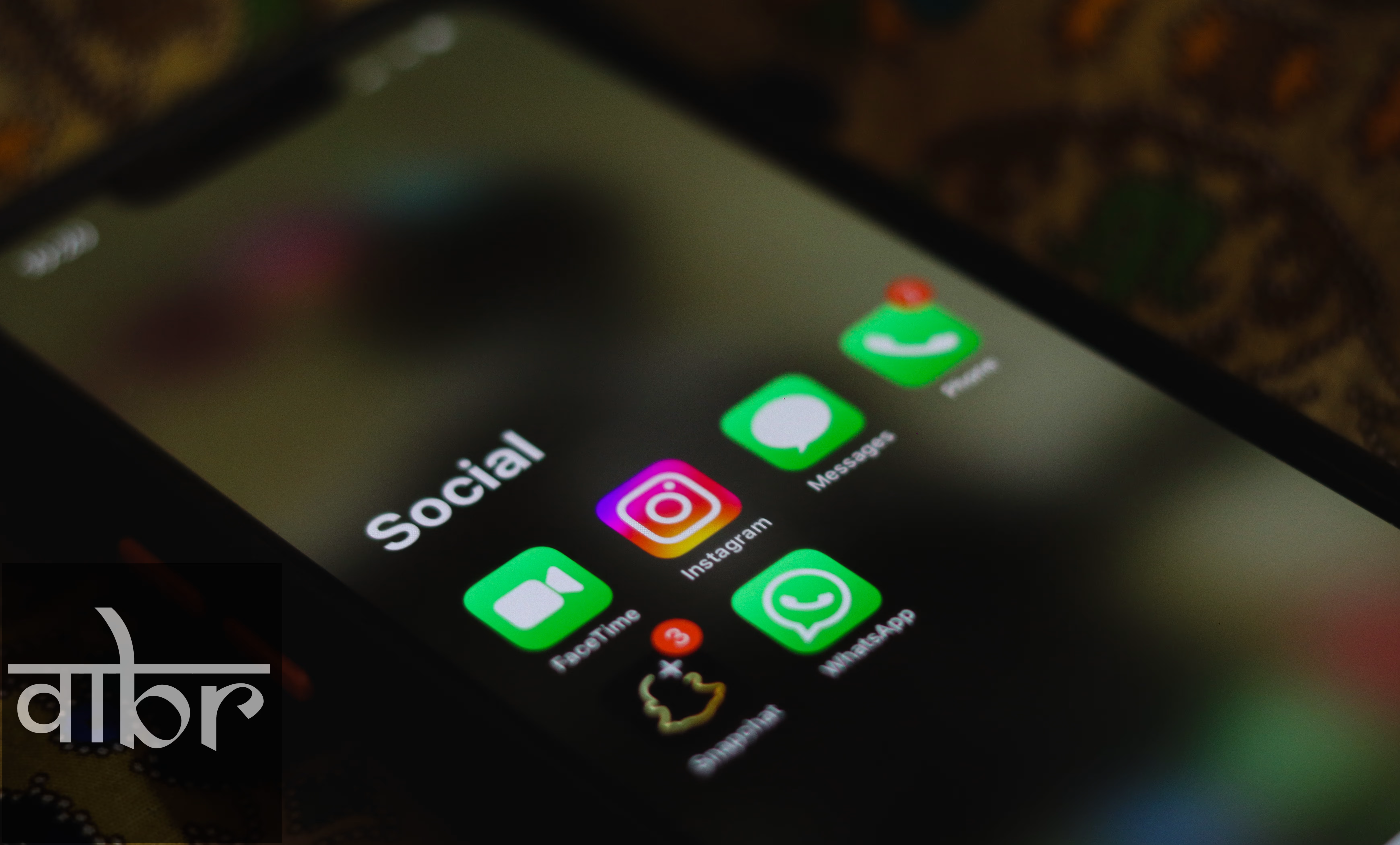
Every time you send a private text, check your bank balance, or back up photos, your data travels across miles of public internet cables, cell towers, and corporate data centers. Without strong cryptographic safeguards, anyone sitting between your device and the destination—rogue network operators, internet service providers, or hostile hackers—could read every word.
Most modern services boast that they use "encryption," but not all encryption shields you equally. Standard transit encryption protects your data on the wire, yet leaves it wide open to the companies running the servers.
End-to-end encryption (E2EE) fixes this structural vulnerability. It guarantees that only the communicating users hold the keys to decode the conversation, rendering everyone in between—even the platform hosting the chat—completely blind to the content.
The Fundamental Mechanics: How E2EE Actually Works
To understand why E2EE is the gold standard of digital privacy, consider how standard encryption handles your data compared to an end-to-end encrypted architecture.
Encryption in Transit vs. End-to-End Encryption
When you use standard web services (like traditional email or standard SMS), your messages use Encryption in Transit (typically via TLS/HTTPS):
- Your phone encrypts the message and sends it over the internet.
- The service provider’s central server decrypts the message, reads it, checks for spam or moderation flags, and re-encrypts it.
- The server transmits the newly encrypted packet to the recipient’s phone, which decrypts it.
While this protects against someone intercepting your data on public coffee shop Wi-Fi, the central server has full, unencrypted access. If law enforcement subpoenas that company, an insider goes rogue, or a hacker breaches the central database, your plaintext messages are exposed.
The End-to-End Encryption Architecture
Under end-to-end encryption, the encryption and decryption steps occur exclusively on endpoint devices (your phone and the recipient's phone). The central server acts merely as a blind courier passing scrambled ciphertext:
- Key Generation: When you install an E2EE application, your device generates two mathematically linked cryptographic keys: a public key (shared openly with the server's directory) and a private key (locked permanently inside your device's secure hardware enclave).
- Message Scrambling: When you text a friend, your app retrieves their public key and uses it to mathematically lock your text.
- Blind Transmission: The resulting scrambled string (ciphertext) travels through the provider’s routing servers. Because the server does not hold your friend’s private key, it cannot read the content.
- Endpoint Decryption: The recipient's device receives the ciphertext and uses its local private key to unlock and display the original message.
Asymmetric Cryptography and the Signal Protocol
Modern secure messaging does not rely on static key pairs alone. If an attacker stole your private key years from now, a static setup might let them decrypt an archive of past intercepted conversations.
To prevent this, leading platforms rely on the Signal Protocol (originally developed by Open Whisper Systems), which uses the Double Ratchet Algorithm to achieve two critical security properties:
- Forward Secrecy: The cryptographic keys protecting your conversation regenerate continuously with every single message sent. If an adversary compromises your device’s current cryptographic key, they can only read the latest message; they cannot decrypt your historical chat logs.
- Break-in Recovery (Post-Compromise Security): If a malicious actor temporarily intercepts a key, the ratchet mechanism automatically heals the encryption channel as soon as normal messaging resumes, locking the attacker back out.
Comparing Popular Messaging and Cloud Platforms
Not every messaging app that claims to be secure turns on end-to-end encryption out of the box. Some bury it behind optional settings, while others log significant metadata alongside your messages.
Platform | E2EE by Default? | Underlying Protocol | Metadata Collection | Zero-Knowledge Cloud Backups? |
|---|---|---|---|---|
Signal | Yes (Always on) | Signal Protocol (Open Source) | Minimal (Only registers sign-up timestamp and last connection date) | Optional, encrypted local backups only |
Yes (Always on) | Signal Protocol | High (Collects contact lists, device telemetry, timestamps, IP addresses) | Optional (Must manually toggle "End-to-End Encrypted Backup") | |
iMessage | Yes (Apple to Apple) | Apple Custom Proprietary E2EE | Moderate (Stores transaction logs and delivery routing details) | Only if Advanced Data Protection is enabled in iCloud |
Telegram | No (Cloud chats are plaintext to servers) | MTProto (Proprietary) | High (Stores full chat histories and media across server infrastructure) | No (Telegram holds the server-side decryption keys) |
Google Messages (RCS) | Yes (For 1-on-1 and RCS group chats) | Signal Protocol implementation | Moderate (Carrier and Google routing metrics) | Managed via standard Android cloud backups |
Note on Telegram: Telegram's default chats are not end-to-end encrypted. They are stored on Telegram’s cloud servers where the company holds the decryption keys. E2EE only functions in Telegram if you manually initiate a one-on-one "Secret Chat."
What E2EE Protects—and What It Cannot Prevent
End-to-end encryption is a robust shield for message payloads, but it is not a silver bullet for overall device security.
What E2EE Successfully Defends Against
- Man-in-the-Middle (MitM) Attacks: Wiretapping by internet service providers, rogue Wi-Fi hotspots, or nation-state telecom monitors.
- Server-Side Data Breaches: If the messaging provider’s cloud infrastructure is hacked, attackers extract only indecipherable ciphertext.
- Government Subpoenas for Chat Logs: A company cannot hand over plaintext message transcripts it does not possess.
What E2EE Does Not Protect
- Endpoint Compromise: If your phone is infected with spyware, keyloggers, or malware, attackers can capture screenshots or read text straight from your screen before encryption occurs.
- Unprotected Cloud Backups: If you write end-to-end encrypted messages on WhatsApp or iMessage but back up your chat history to unencrypted Google Drive or standard iCloud vaults, the cloud provider holds a plaintext copy of your database.
- Metadata Exposure: E2EE encrypts the content of the message, but it does not completely conceal traffic analysis. Providers may still log who you communicate with, your IP address, how frequently you interact, and the size of transmitted data packets.
How to Audit and Maximize Your E2EE Security
To ensure your communications are thoroughly protected, take three immediate configuration steps:
- Verify Safety Numbers (Key Verification): In apps like Signal and WhatsApp, open a contact's profile and select View Safety Number or Verify Security Code. Scanning each other's QR codes in person confirms that no intermediate proxy has swapped out public keys.
- Encrypt Your Cloud Backups: On WhatsApp, navigate to Settings > Chats > Chat Backup and toggle on End-to-End Encrypted Backup. On Apple devices, open your iCloud settings and turn on Advanced Data Protection so your device backups cannot be accessed by Apple.
- Use Disappearing Messages: If you discuss sensitive personal or financial information, turn on disappearing messages. This removes the local transcript from both devices after a set window, mitigating the risk of someone physically browsing through your unlocked phone.
Frequently Asked Questions
Can police or intelligence agencies break end-to-end encryption?
Modern cryptographic standards like AES-256 and Curve25519 cannot be broken through brute-force computation with existing hardware. Instead of breaking the math, law enforcement agencies target endpoints directly: seizing unlocked devices, using forensic extraction tools (like Cellebrite), exploiting zero-day operating system vulnerabilities, or subpoenaing unencrypted cloud backups.
Does WhatsApp sharing data with Meta mean my messages are read?
No. Meta cannot read the text, audio, or media sent inside WhatsApp chats because the Signal Protocol runs client-side. However, Meta does collect and cross-reference behavioral metadata—including your phone number, interaction frequency, diagnostic metrics, and IP address—for marketing and infrastructure purposes.
Why don't all companies use end-to-end encryption by default?
E2EE requires companies to surrender valuable data processing features. When a service cannot read your data, it cannot parse your messages to serve targeted ads, train artificial intelligence models, offer server-side keyword searching across years of history, or easily moderate hate speech and spam.
The Bottom Line
End-to-end encryption flips the traditional security model on its head. Instead of forcing you to trust that a technology corporation will safeguard your private thoughts, financial records, and sensitive photos on its servers, E2EE uses zero-knowledge cryptography to ensure they never hold the keys in the first place.
For daily messaging, defaulting to platforms like Signal, iMessage with Advanced Data Protection enabled, or WhatsApp with encrypted backups active is one of the most significant privacy upgrades you can make.
Varta Brief Editorial Desk
• Newsroom StaffDedicated to objective, deep, and fact-verified reporting across technology, science, world affairs, and modern markets.
Follow Varta Brief on Google
Add Varta Brief as a preferred source to see our verified stories and daily briefings in Google Top Stories and Discover.
Found this briefing insightful?
Share it with your colleagues and community.
